
Watercolor Paintings of Famous Landmarks: 2026 Guide
Table of Contents
- Why Watercolor Landmarks Belong in Your Home
- Original Watercolor Cityscapes vs. Digital Prints
- Iconic Landmarks That Shine in Watercolor
- How to Choose Watercolor Art for Home Decor
- Commissioning Custom Landmark Paintings: What to Expect
- Famous Watercolor Artists Who Painted Landmarks
- How to Display and Care for Your Watercolor Landmark Art
- Conclusion
- Frequently Asked Questions
Last Updated: September 29, 2026
Why Watercolor Landmarks Belong in Your Home
Watercolor paintings of famous landmarks turn a travel memory into something you can live with every day. This guide from Zachary Zleetni Art breaks down how to choose, commission, and care for them. A painting of the Eiffel Tower or Brooklyn Bridge does more than fill wall space. It anchors a room with a story only you can tell.
The appeal comes down to three things:
- Personal memory. A landmark you've actually stood in front of carries meaning a generic print never will.
- Visual softness. Watercolor's translucent washes sit quietly on a wall instead of shouting for attention.
- Material honesty. You can see the paper texture and brush marks, which is exactly what the Metropolitan Museum of Art's overview of watercolor technique describes as the medium's defining quality.
Most homeowners underestimate how much a single well-placed piece changes a room's character.
Original Watercolor Cityscapes vs. Digital Prints
An original watercolor cityscape is a one-of-a-kind painting on paper, while a digital print is a reproduced image, often printed in unlimited runs. That distinction drives everything else: price, longevity, and how the piece feels in a room.
Here's how the two compare in practice:
| Factor | Original Watercolor | Digital Print |
|---|---|---|
| Uniqueness | One of a kind | Reproduced in multiples |
| Surface | Visible paper texture, real pigment | Flat, uniform finish |
| Longevity | Can last generations with care | Fades faster in direct light |
| Resale | Holds value as fine art | Little to no resale value |
| Price | Higher, reflects the artist's time | Lower, mass-produced |
A common mistake is buying a "hand-finished" print assuming it's original. Ask directly whether the piece is painted on paper or printed, and request a photo of the actual surface.
Iconic Landmarks That Shine in Watercolor
Some landmarks translate to watercolor better than others. The ones that work share three traits: a strong silhouette, layered depth (foreground, midground, sky), and surfaces the medium can suggest rather than render literally. Here is how the most-painted landmarks behave on paper, plus the technique each one rewards.
European Icons: Big Ben, Eiffel Tower, and Colosseum
Big Ben (Elizabeth Tower). The clock face and spire give the eye a clear focal point, which matters because watercolor has no white paint to fall back on, the paper itself is the highlight. Painters typically mask or carefully reserve the clock face, then lay a graded wash of Payne's Gray and a touch of burnt sienna across the London sky. The tower itself is mostly silhouette work: a single dark value with a few lifted highlights for stone texture.
Eiffel Tower. The lattice ironwork is the trap.
American and Asian Landmarks: Brooklyn Bridge, Tokyo Tower
Brooklyn Bridge. The suspension cables are leading lines, and watercolor handles them best with a dry-brush technique, dragging a nearly dry brush across rough paper to get broken, textured lines rather than uniform strokes. The East River below is a classic wet-in-wet wash, and the Manhattan skyline behind is kept deliberately pale so the bridge stays the subject.
A Short History of Landmark Painting
Landmark painting is not a modern trend. Canaletto painted Venice's canals and palazzi in the 18th century for Grand Tour travelers who wanted a souvenir of their trip, essentially the original commission market. J.M.W. Turner pushed the same subject matter toward atmosphere, dissolving Venice into light and mist. In the 19th and 20th centuries, John Singer Sargent carried watercolor travel scenes across Europe and the Middle East, and the urban sketching movement that grew in the late 20th century turned on-location landmark painting into a global practice.
How to Choose Watercolor Art for Home Decor
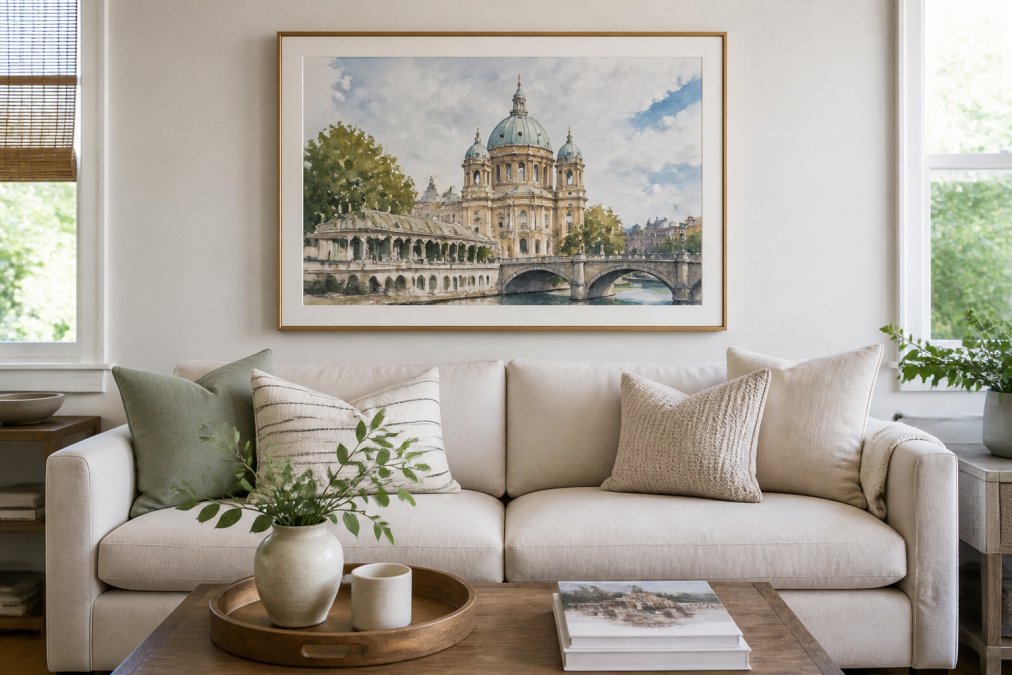
Choosing watercolor art for home decor comes down to three checks: scale, palette, and placement. Get those right and almost any landmark piece will work in your space.
Commissioning Custom Landmark Paintings: What to Expect
Commissioning custom landmark paintings means hiring an artist to create a piece based on a location you choose. The process usually runs through a few clear stages, and knowing them upfront prevents most delays.
A typical commission works like this:
- Share your reference. Send photos of the landmark from your own trip if you have them.
- Agree on size and format. Confirm dimensions, orientation, and whether it's framed or unframed.
- Approve a sketch or color study. Many artists share an early version before committing to the final painting.
- Set a timeline. Ask for a realistic completion window and a shipping date.
- Confirm the terms. Clarify deposit, revision policy, and what happens if you're unhappy with the result.
Famous Watercolor Artists Who Painted Landmarks
Landmark painting has a long history, and knowing a few names helps you recognize quality when you see it. This is the curated list most stock-image sites skip, the creators behind the genre, not just the end product.
The Historical Benchmarks
J.M.W. Turner (1775-1851). The single most influential watercolorist of landmarks. His Venetian scenes, the Grand Canal, Santa Maria della Salute, dissolved architecture into atmosphere, using wet-in-wet washes and reserved paper to suggest light rather than describe buildings. Turner's approach is why so many contemporary landmark painters favor loose washes over tight line work. The Tate's collection of Turner's watercolor works is the best public place to study how far the medium can be pushed.
The Modern and Contemporary Names
Joseph Zbukvic. An Australian watercolorist whose cityscapes and landmark scenes are widely studied for their control of water and value. His work is often cited by contemporary painters as a model for atmospheric urban scenes.
Why This Matters When You Buy
An artist who understands composition, perspective, and value, not just color, produces work that holds up on a wall for decades. When you look at a landmark painting, ask yourself: does the artist understand how the building actually sits in space? Are the darks committed, or are they timid? Is the paper doing work, or is every inch covered? Those questions come straight from the painters above, and they are the fastest way to separate a serious landmark watercolor from a decorative one.
How to Display and Care for Your Watercolor Landmark Art
Caring for watercolor art is mostly about light and framing. Watercolor pigment sits on the surface of the paper, which makes it more sensitive to ultraviolet light than oil or acrylic paint.
Follow these habits to protect your piece:
- Frame behind UV-filtering glass. Standard glass blocks some light, but UV glass blocks far more.
- Keep it out of direct sun. Even brief daily exposure adds up over years.
- Use an acid-free mat. Cheap mats can yellow and stain the paper over time.
- Control humidity. Damp rooms encourage mold, which is very hard to reverse on paper.
- Dust with a dry, soft brush. Never spray cleaner onto the glass or frame.
- Hang away from heat sources. Radiators and fireplaces dry out paper and cause warping.
Conclusion
Building a collection of watercolor paintings of famous landmarks takes a little care, but the payoff is a home that reflects where you've been and what you love. Start with one piece tied to a place that genuinely means something to you, then let the collection grow from there.
Frequently Asked Questions
What makes watercolor the ideal medium for painting famous landmarks?
Watercolor captures light and atmosphere in ways opaque paints cannot. Its transparent washes mimic sky gradients, stone textures, and reflections on water, giving landmarks a sense of place. The medium also allows for loose, expressive strokes that convey the energy of a cityscape without photorealistic detail. For watercolor landmarks, this means each piece feels both accurate and artistic, preserving the character of the structure while adding a personal, hand-drawn touch that digital prints lack.
How do I choose the right watercolor landmark painting for my living space?
Start by considering the room's color palette and scale. A large wall needs a statement piece, while smaller spaces suit intimate compositions. Think about the mood you want: soft washes for calm, bolder pigments for energy. For original watercolor cityscapes, check the painting's dominant hues against your existing decor. If you are commissioning custom landmark paintings, share photos of your space and favorite travel memories with the artist to guide the composition and palette.
Are original watercolor paintings of landmarks a good investment?
Original art can hold or grow in value, especially when created by an artist with a distinct style and growing recognition. Unlike mass-produced prints, each watercolor is unique, and its scarcity supports long-term worth. However, art should first bring you joy. If a piece resonates with your travel memories or heritage, its personal value is immediate. For those commissioning custom landmark paintings, the investment is also emotional, turning a cherished location into a lasting keepsake.
How does Zachary Zleetni Art capture the character of global structures?
Zachary Zleetni Art focuses on clarity and restraint, using precise architectural sketches and layered watercolor washes to highlight each landmark's defining features. The country-themed collections group works by region, making it easy to find a piece that reflects your heritage or travel history. Each painting is an original, hand-painted watercolor, not a digital reproduction, so you receive a one-of-a-kind artwork that tells a story through composition, color palette, and paper texture.