
Original Watercolor vs Mass-Produced Art: Which Should You Buy?
Last Updated: October 25, 2026
Quick Summary
Original watercolor vs mass produced art comes down to uniqueness and longevity. Original watercolors are one-of-a-kind hand-painted pieces that hold or appreciate in value and last for decades, while mass-produced prints are affordable reproductions that depreciate and fade within 20-30 years. Choose originals for investment and authenticity, or prints for budget-friendly decor.
- Original watercolors show visible brushstrokes and tactile texture you can feel, while prints have smooth, uniform surfaces.
- Original paintings typically hold or increase in value over time, whereas mass-produced art depreciates or remains static.
- Giclée prints are the highest quality reproductions but still fade faster than archival watercolor pigments.
- Commission a custom watercolor painting tailored to your space for a unique piece no one else will own.
- Original watercolors remain vibrant for decades to centuries with proper care, compared to 20-30 years for giclée prints.
Table of Contents
- Original Watercolor vs Mass-Produced Art: Key Differences
- How to Tell If a Watercolor Is Original
- Original Watercolor Painting vs Print: Understanding the Distinction
- Understanding Watercolor Giclée Prints and Fine-Art Reproductions
- Pricing, Value, and What You're Actually Paying For
- Commission a Watercolor Painting Tailored to Your Space
- Choosing Between Original and Mass-Produced Art for Your Home
- Frequently Asked Questions
Original Watercolor vs Mass-Produced Art: Key Differences
When you're deciding what to hang on your walls, understanding original watercolor vs mass produced art shapes not just your space, but your relationship with the work itself. Original watercolor paintings and mass-produced art differ fundamentally in how they're created, what they cost, and how they age. Understanding these distinctions helps you make a choice that aligns with your values and your home.
An original watercolor is a one-of-a-kind painting created by hand on paper using pigment and water. Mass-produced art refers to prints, reproductions, and decor items manufactured in quantity through mechanical or digital processes. The difference isn't just about exclusivity, it's about authenticity, permanence, and the story the work tells.
At Zachary Zleetni Art, we create original watercolor paintings that capture the character of streets, structures, and stories from around the world. Each piece is hand-painted on quality watercolor paper, which means no two works are identical. When you choose an original, you're investing in a painting that was made specifically by an artist's hand, not reproduced from a design.
The core distinction matters because it affects durability, value, and how the work connects to your space. Original paintings hold their colors and integrity differently than prints. They also tend to appreciate or maintain value in ways that mass-produced art cannot match.
How to Tell If a Watercolor Is Original
An original watercolor painting exhibits unmistakable physical characteristics that distinguish it from prints or reproductions. The most reliable way to verify authenticity is to examine the work in person, though understanding what to look for helps even when shopping online.
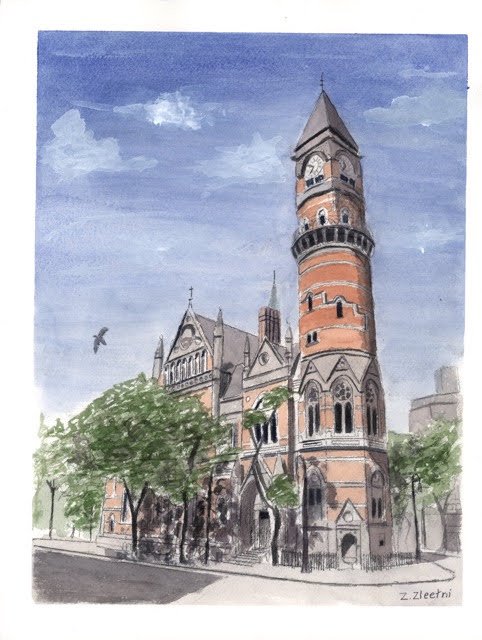
Look for visible brushstrokes and layers of pigment. Learn more about what makes watercolor paintings authentic to deepen your understanding of these markers.
Run your finger gently across the surface (if the work permits). Original watercolors have tactile texture. You'll feel the raised paint, the grain of the paper, and sometimes the slight irregularities that come from hand application.
Check the edges and back of the work. Original paintings show the raw edge of the watercolor paper.
Examine the pigment consistency. Watercolor pigment has depth and transparency. Light passes through the layers, creating luminosity that photographs well but feels different in person.
Look for the artist's signature. Original watercolors are typically signed by the artist, often in the corner. The signature should be consistent with the artist's documented hand.
Original Watercolor Painting vs Print: Understanding the Distinction
The difference between an original watercolor painting and a print comes down to creation method and uniqueness. A print is a reproduction of an original work, created by scanning or photographing the painting and then reproducing it mechanically or digitally.
Original watercolor paintings are created once. The artist paints directly on paper using pigment and water. That single work is the only version that exists in that exact form. When you purchase an original, you own the actual object the artist created.
Prints are reproductions made from an original. The artist creates one painting, then that image is scanned and reproduced many times. A limited-edition print might be reproduced 100 or 500 times. An open-edition print can be reproduced indefinitely. Each print is identical to the others in the edition.
This distinction affects several practical aspects of ownership. Original paintings are unique, no one else owns an identical work. Prints are multiples, many people may own the same image. Original paintings typically appreciate in value or hold their value because scarcity increases demand.
Original watercolors age differently than prints. The pigments and paper used in quality originals are archival and fade slowly over decades. Prints fade faster because ink is less stable than watercolor pigment, and paper quality varies widely depending on the print method used.
Understanding Watercolor Giclée Prints and Fine-Art Reproductions
A giclée print is a specific type of fine-art reproduction made using inkjet technology. The term comes from the French word "gicler," meaning to spray. Giclée printing uses high-quality pigment-based inks sprayed onto archival paper or canvas to create a detailed reproduction of an original artwork.
Giclée prints represent the highest quality among mass-produced art. They capture color and detail more accurately than older printing methods like lithography or screen printing. For that reason, they're often marketed as fine-art reproductions and priced higher than standard prints.
The process begins with a high-resolution scan of the original painting. That digital image is then color-corrected to match the original as closely as possible. The printer then outputs the image using multiple ink colors at high resolution.
What giclée prints lack is the physical presence of the original. There's no brushwork to see, no texture to feel, no unique variations from one copy to the next. Every giclée print in an edition looks identical. The pigment sits on the surface rather than being layered into the paper.
Fine-art reproductions also include canvas reproductions, which are giclée prints applied to canvas to simulate the texture of a painting. These create a visual approximation of brushwork through the canvas weave, but they're still prints, the image is not hand-painted.
Pricing, Value, and What You're Actually Paying For
Original watercolor paintings and mass-produced art occupy different price tiers because they offer different value propositions. Understanding what you're paying for helps clarify which option matches your budget and intentions.
Original watercolor paintings command higher prices because each work is unique and created by hand. The artist invests time, skill, and materials into a single piece. Once sold, that specific painting cannot be reproduced, there's only one.
Mass-produced art costs less because the initial creation happens once, then the image is reproduced many times. The cost is distributed across all copies, making each individual print affordable.
The trade-off is that mass-produced art doesn't appreciate. Understand why investing in original watercolor art makes sense for long-term value and ownership satisfaction. A print you buy today will likely be worth less or the same in ten years.
Consider also the longevity of your investment. Original watercolors made with quality materials and proper care last for decades or centuries. Giclée prints fade over 20-30 years depending on light exposure. Standard prints fade faster.
Commissioning an original watercolor gives you another option. This allows you to own a unique work without the uncertainty of finding exactly what you want among existing inventory. Commission a watercolor painting tailored to your space for more on this option.
Commission a Watercolor Painting Tailored to Your Space
Commissioning an original watercolor painting means working directly with an artist to create a custom work designed specifically for you. This approach bypasses the limitations of buying from existing inventory, you get exactly what you envision.
The commission process typically begins with a conversation about your vision. You describe the location, mood, style, or subject matter you want captured. The artist then creates preliminary sketches or studies to ensure you're aligned on direction. Once approved, the artist paints the final work on quality watercolor paper.
Commissions take longer than purchasing existing work, typically several weeks depending on the artist's schedule and the complexity of the piece. This timeline allows for thoughtful creation rather than rushed production.
The advantage of commissioning is customization. You can request a specific city you've traveled to, a meaningful building or street, or a particular color palette that matches your décor. You own the original from the moment it's complete, and no one else will own an identical work. Zachary Zleetni Art creates original watercolor paintings available for commissions, allowing you to own a custom piece that captures your personal connection to a place or story.
Commissioning also builds a relationship with the artist. You're supporting their work directly and participating in the creative process. This personal connection often makes the finished piece more meaningful than a work you selected from existing options.
Choosing Between Original and Mass-Produced Art for Your Home
Your choice in original watercolor vs mass produced art depends on several practical considerations: your budget, how long you plan to keep the work, whether you want something unique, and what role the art plays in your space.
Choose original watercolor art if you want a unique, one-of-a-kind piece that you'll live with long-term. Originals make sense if you value authenticity, appreciate visible brushwork and texture, or see the art as an investment.
Choose mass-produced art if you want affordable decor, prefer a specific image that exists in multiple copies, or plan to rotate art frequently.
Consider a hybrid approach: commission an original watercolor for your main living space, and use prints or reproductions in secondary rooms. This balances investment with coverage.
Think about the story you want the art to tell. Original paintings carry the artist's hand and intention in a way prints cannot. They age visibly, developing character over time. Prints remain static, they don't change or develop patina.
| Consideration | Original Watercolor | Mass-Produced Art |
|---|---|---|
| Uniqueness | One-of-a-kind | Multiple identical copies |
| Visible brushwork | Yes, tactile texture | No, flat surface |
| Long-term value | Holds or appreciates | Depreciates or static |
| Archival quality | Decades to centuries | 20-30 years |
| Price range | Higher initial cost | Lower cost |
| Customization | Available via commission | Limited to existing designs |
| Emotional connection | Strong, personal | Moderate, shared with others |
The decision ultimately reflects what art means to you. If you view it as decoration, mass-produced options serve that purpose affordably.
The right artwork transforms how you feel about your space. Original watercolor paintings bring character and authenticity that mass-produced art cannot replicate.
Frequently Asked Questions
What is the difference between an original watercolor and a print?
An original watercolor is a one-of-a-kind painting created by hand on paper using watercolor pigments and brushes. A print is a reproduction made from a photograph or scan of the original, typically produced on a printer or through commercial printing methods. Original watercolors have visible brushstrokes, unique texture, and layers that cannot be replicated exactly; prints appear uniform and flat. Originals hold collectible value and are irreplaceable, while prints are mass-produced copies with limited resale value.
How can you tell if a watercolor painting is original?
Look for visible brushstrokes, uneven pigment application, and raised texture on the paper surface. Originals show the artist's hand in color variations and layering. Check for a signature, typically on the front or back. Ask the seller for provenance or a certificate of authenticity. Examine the paper quality, professional-grade watercolor paper has a distinct feel and finish. Be cautious of paintings that appear too uniform or perfectly printed; authentic originals show natural imperfections and variation that prove they were hand-painted.
Are watercolor prints considered original art?
No. Watercolor prints are reproductions of original paintings, not original art themselves. They are created by scanning or photographing an original watercolor and then printing copies using inkjet, lithography, or giclée methods. While fine-art prints can be high-quality and beautiful, they are mass-produced multiples. A true original watercolor is a single, hand-painted work that exists as a one-of-a-kind piece. If you want original artwork, look for pieces directly created by the artist on paper, not reproductions printed afterward.
Should I buy an original watercolor or a mass-produced print for my home?
Choose based on your priorities. Original watercolors suit collectors, gift givers seeking meaningful pieces, and anyone wanting irreplaceable, hand-crafted art that holds sentimental and potential resale value. Mass-produced prints work well for budget-conscious buyers, those decorating multiple rooms, or anyone wanting art without commitment. Consider whether you value uniqueness, authenticity, and the artist's hand in the work. Zachary Zleetni Art offers original watercolor paintings capturing stories from around the world, ideal if you want sophisticated, one-of-a-kind pieces. The brand also offers commissions if you're looking for art tailored to your specific space or travel memories.
